The Fahill Nations
- Description:
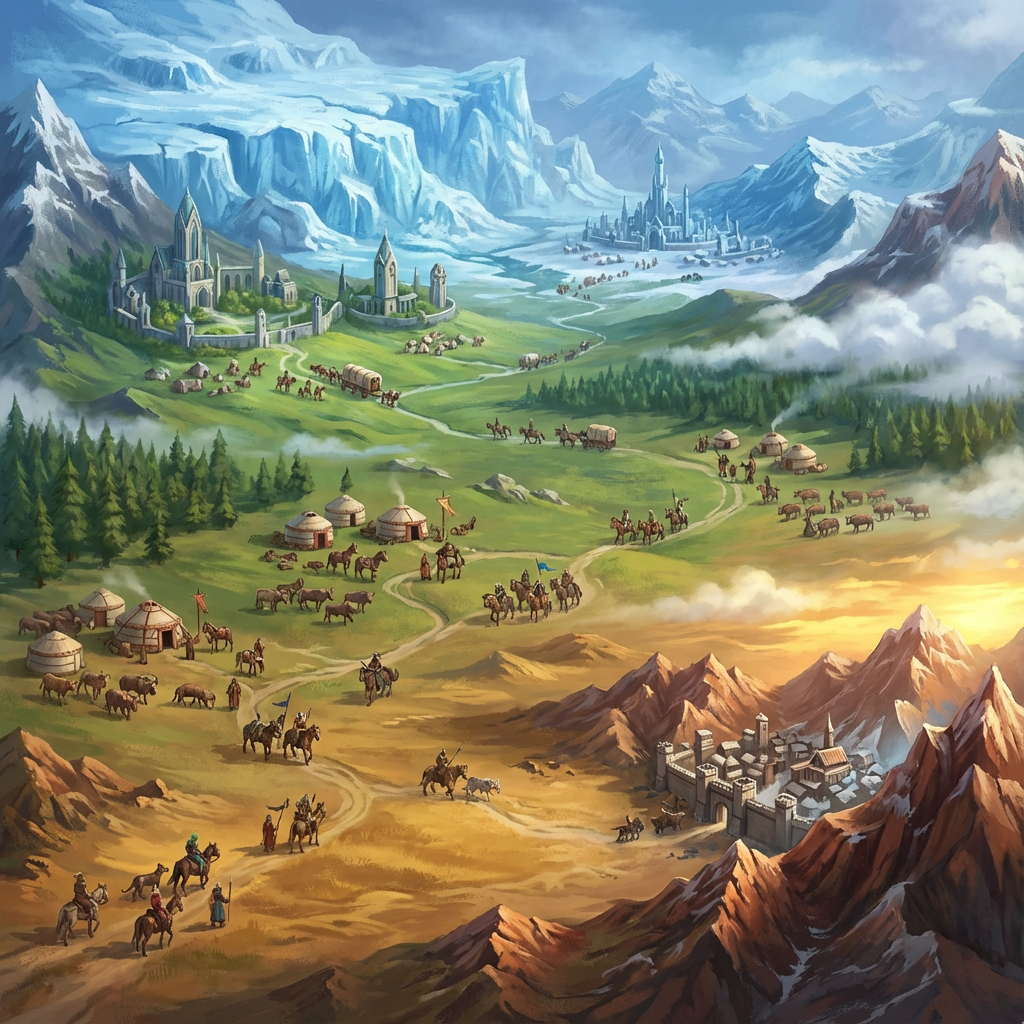
- A sprawling northern territory governed by seasonal migration, where nomadic tribes traverse vast plains between the glacial north and the southern mountain peaks.
- Parent:
- Aillutia
Sub-Locations
Geography and Climate
The Fahill Nations occupy the northern half of their shared continent, bounded by the icy reach of the northern glaciers and the formidable mountain peaks that separate them from Scieles. This expansive region is defined by a central corridor of rolling plains and scattered boreal forests.
The climate functions on a strict thermal cycle. The southern reaches are temperate throughout the winter months but become arid and inhospitable during the summer. Conversely, the north remains trapped in a lethal deep-freeze during the winter, thawing into a lush, fertile environment during the summer. This environmental duality dictates the rhythm of all life within the territory.
The Great Migration
The inhabitants of the Fahill Nations—primarily Elves, with significant populations of other hardy races—are largely nomadic. They do not view land as something to be owned, but as a resource to be followed. This movement is not chaotic; it is a calculated, mathematical journey known among Aillutian scholars as the 'Thermal Transit'.
The Seasonal Capitals
- The Northern Solstice (Summer Seat): A city of elegant, pale stone designed to catch the maximum amount of sunlight. It remains a ghost town for half the year, preserved by the ice, only to bustle with life as the tribes arrive for the summer thaw.
- The Southern Equinox (Winter Seat): Located near the mountain passes, this city is built into the foothills to provide natural insulation against the winds. It serves as the primary hub for the limited trade routes connecting to Scieles during the winter months.
Society and Governance
While the Age of Reason views the Fahill people as 'efficient survivalists,' the tribes themselves maintain a culture deeply rooted in the cycles of the world.
- The Tribes: Numerous distinct nomadic groups travel along established 'Ley-Lines' (interpreted by modern scholars as high-efficiency migratory paths). While Elves are the most populous, Orcish and Human tribes also participate in the migration, each maintaining their own seasonal village sites along the central plains.
- Trade and Isolation: Contact with the south is strictly regulated. Only a few treacherous mountain passes allow for the exchange of goods. The Fahill export rare boreal timber and glacial minerals in exchange for advanced Arcane Science tools from Scieles and Coplin.
Academic Perspective
In the archives of Aillutia, the Fahill Nations are often cited as a prime example of 'Environmental Optimization'. Academics argue that their nomadic lifestyle is not a lack of civilization, but a refined mathematical response to the continent's extreme axial tilt and resource distribution. Any lingering tribal folklore regarding the 'Spirit of the Wind' or 'Glacial Guardians' is formally classified as a localized cultural delusion resulting from prolonged exposure to high-altitude mana.